School Bus Simulator Driving
Games2win.comRacing
4.34.66K Reviews
- Version
- 8.2
- Installs
- 10.00M
- Age Rating
- Everyone
Screenshots
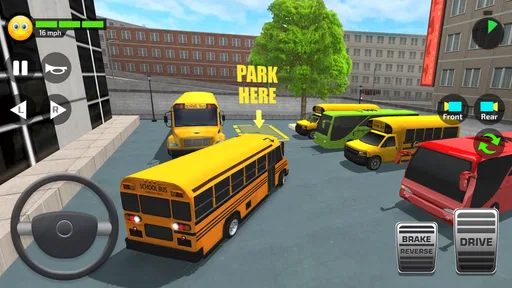
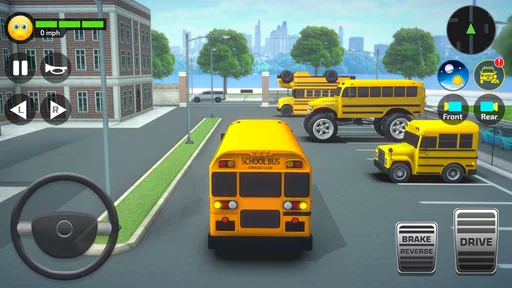
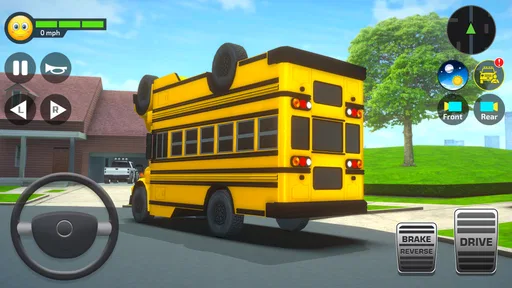
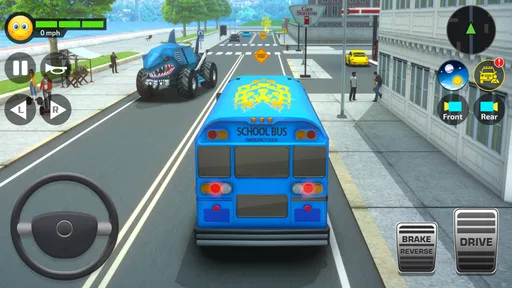
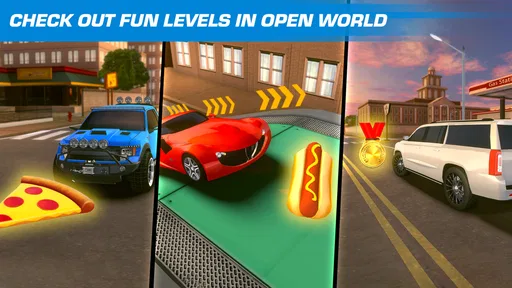
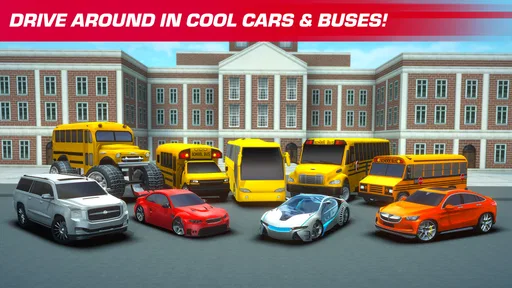
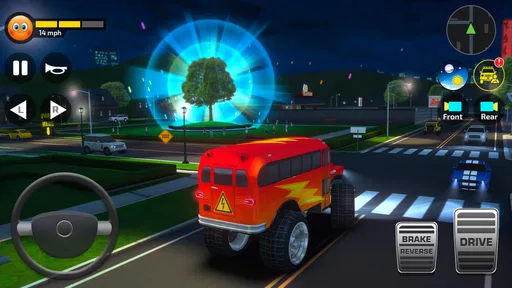
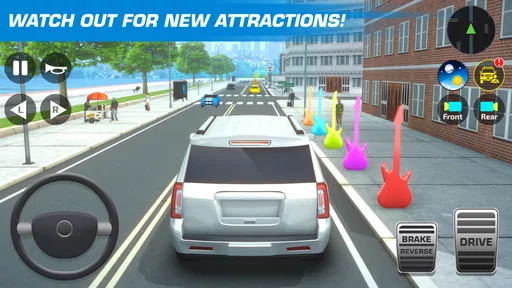
Our Review of School Bus Simulator Driving
 Analysis by Appyee
School Bus Simulator Driving is the kind of racing game I open when I want something slower and more deliberate than a typical car game. Instead of chasing speed around a track, I am asked to handle a school bus, follow the road, and park with enough care to make the journey feel controlled. That change of pace is the main reason it stands out in a crowded mobile racing category.
Developed by Games2win.com, this free game is aimed at players who enjoy vehicle handling, parking challenges, and the small tension that comes from trying not to damage a large vehicle. It is rated for Everyone, so the presentation is accessible to a broad audience. The game has reached over ten million installs and holds a 4.3 average from around eighty thousand ratings, which suggests that the idea has found a substantial audience without making it a guaranteed fit for every player.
I found the most useful way to approach it is as a driving practice game rather than a conventional racer. It rewards patience, observation, and small steering corrections. If you expect constant overtaking, dramatic crashes, or a deep competitive ladder, you may feel restricted. If you like the satisfaction of lining up a difficult turn or fitting a long vehicle into a marked space, its slower rhythm makes more sense.
What the driving loop feels like in everyday play
The central appeal is straightforward: I take control of a school bus and work through driving and parking situations. The bus changes the way I think about every movement. A turn that would be effortless in a small car needs earlier steering, more room, and a better sense of where the rear of the vehicle is going. That makes ordinary-looking actions surprisingly engaging.
My first useful adjustment was to stop treating the steering as something to hold continuously. Short inputs work better than a long, confident swipe or button press, especially when approaching a narrow entrance. I also learned to begin positioning before the turn rather than trying to correct everything halfway through it. Those habits are more valuable here than simply driving quickly.
A realistic everyday scenario is a short session during a commute or while waiting for an appointment. I can play one situation, put the phone down, and return later without needing the commitment of a long racing event. The game suits that kind of fragmented time because the objective is easy to understand: reach the required area and handle the bus carefully. It is less suitable when I want a quick burst of action that feels exciting from the first second.
The bus itself creates a useful trade-off. Its size gives the game a clear identity, but it also makes mistakes feel more noticeable. A tight corner is not difficult because the controls are necessarily complicated; it is difficult because the vehicle has momentum and length. I recommend using the edges of the road and nearby objects as visual references instead of staring only at the front of the bus. The front may appear clear while the rear is still cutting across a barrier.
Why parking is more interesting than racing
The parking side is where the concept becomes more distinctive. In a normal racing game, slowing down usually means losing. Here, slowing down is often the correct decision. I get better results by approaching a space at a controlled pace, leaving room for a correction, and turning earlier than instinct suggests. The challenge is not just reaching a destination; it is arriving in a position that leaves the bus aligned.
One practical technique is to make the final approach in stages. I first arrange the nose of the bus, then check how the rear is tracking, and only then make the last correction. Trying to solve all three points with one movement tends to produce oversteering. This is a small detail, but it changes the game from frustrating trial and error into a more readable driving exercise.
That also explains why the game may appeal to younger players and casual users. The premise is familiar, the age rating is Everyone, and the objective does not depend on understanding a complicated fictional world. At the same time, younger players may need patience with the vehicle’s turning space. It is easy to interpret a missed parking attempt as a control problem when the real issue is entering too quickly.
The current version is 8.2, and the game requires Android 7.0 or later. Those details matter if I am installing it on an older phone or a device kept for children. On a compatible device, I would still recommend checking how comfortable the screen feels in both hands before judging the controls. Large vehicles benefit from precise input, and a cramped display can make a manageable turn feel less predictable.
Progress feels more personal than competitive
The most satisfying form of progress here is improvement in my own driving. I notice that I can take a corner with fewer corrections, judge the rear of the bus earlier, and park without repeatedly repositioning. That is a different reward from unlocking a faster car or beating online opponents. Players who enjoy measurable mastery may appreciate it, while players who need constant new rewards may find the loop modest.
This creates some pressure, but it is mostly self-imposed. I want to complete a route cleanly because a careless turn can undo a good approach. The pressure comes from protecting the quality of the drive rather than from another player watching me. That makes the experience calmer than multiplayer racing, although it can still become tense when a nearly finished attempt fails near the end.
I recommend treating early attempts as route reading rather than wasted runs. The first pass teaches where the bus needs extra space and which approach angle is forgiving. On the next attempt, I can focus on execution. This two-step method is more efficient than restarting immediately after every mistake, because it turns failure into information about the road and the bus’s movement.
The downside is that the game’s appeal depends heavily on whether careful repetition is enjoyable to me. A player who wants a broad career mode, vehicle collecting, or a constantly changing racing structure may prefer a more traditional driving title. This one earns its place through the specific challenge of controlling and parking a school bus, not through variety for its own sake.
Spending, fairness, and what I would check before installing
The game is free to install, with in-app purchases listed from $0.99 to $49.99 per item. That is the purchase context I would keep in mind before handing the phone to a child or starting a longer session. The presence of optional purchases does not by itself tell me whether spending is necessary for progress, so I would not assume that buying anything improves the core driving experience.
My practical approach is simple: I would play the free portion first and decide whether the basic bus handling is enjoyable before considering any purchase. If the main attraction is learning the routes and improving parking, spending should be a separate decision rather than a condition for discovering whether the game suits me. I would also use the device’s purchase protections when children use the same account.
Fairness is harder to judge from the driving concept alone. This is not presented to me as a head-to-head racing game where paid advantages would obviously affect another player’s result. The more relevant question is whether optional spending changes access to content, reduces repetition, or affects the pace of progress. I would look for those differences during play instead of assuming that every purchase is either harmless or essential.
That distinction matters because a free driving game can still be enjoyable without spending if the basic loop provides enough practice. Conversely, even a well-designed parking challenge can feel less fair if progress becomes too dependent on purchases. I would therefore judge value by how much driving variety and replay value I receive before paying, not by the size of the purchase menu.
There are also unknowns that I would keep separate from confirmed facts. I would not promise a particular control scheme, progression structure, advertising experience, or purchase benefit without checking the current version directly on the device. Store details identify the game, its version, compatibility, price model, and audience, but they do not replace hands-on inspection of every screen that may appear during play.
That uncertainty does not make the game a poor choice. It simply means I would install it with realistic expectations. I know I am getting a free school-bus driving game from Games2win.com, not a guarantee of a full simulation with every feature found in a premium console title. For me, that framing prevents disappointment and makes it easier to judge the actual driving rather than an imagined version of it.
Who will enjoy it, and who should skip it
I would recommend it to someone who likes parking games, large-vehicle handling, and short sessions built around careful control. It is especially suitable for players who enjoy improving through repetition and who do not need online competition to stay interested. The Everyone rating also makes it approachable for families, although I would still supervise spending on a shared device.
I would skip it if my main reason for downloading a racing game is speed. The bus is the point, and the bus naturally limits the kind of excitement the game can provide. I would also look elsewhere if I wanted realistic transport management, route planning, passenger systems, or a detailed professional driving simulation. The appeal is the immediate act of driving and parking, not a complete bus-operator career.
Compared with arcade racers, this game trades spectacle for precision. Arcade alternatives usually give me quicker acceleration, sharper turns, and more obvious competition. Compared with parking simulators, it adds the personality and awkward dimensions of a school bus, making the vehicle itself the main obstacle. That middle position is useful: it is more deliberate than an arcade racer but less demanding and comprehensive than a serious simulation.
One non-obvious strength is that the large vehicle teaches me to think about space in a way small-car games often hide. I begin to notice turning arcs, rear clearance, and the consequences of entering a corner at the wrong angle. A weakness follows from the same design: when the visual feedback is not immediately clear, I may blame the controls instead of understanding the bus’s path. Taking slower approaches and using external landmarks helps reduce that confusion.
Another useful trade-off is session length. The focused objectives make it easy to fit into spare moments, but that same focus can make longer sessions feel repetitive if I am not personally motivated by cleaner attempts. I would download it for occasional practice and relaxed play, not expecting it to replace a broad racing game in my library.
My trust verdict after weighing the whole package
School Bus Simulator Driving earns my recommendation as a focused, free racing game with a clear identity. Its best moments come when I stop chasing speed and start reading the bus: how early to turn, how much room the rear needs, and when patience is more useful than another correction. That is a satisfying niche, especially on a phone where a small, understandable challenge can be more appealing than a huge game.
I would keep the spending decision cautious because individual purchases range from $0.99 to $49.99, and I would not treat optional buying as proof of better gameplay. I would first test the free experience, confirm that the controls feel comfortable, and see whether the available progress keeps me interested. That approach protects the value of the download while leaving room to decide later.
The game has been available since August 23, 2016, and its continued presence alongside a 4.3 average and more than ten million installs shows that the school-bus idea has lasting appeal. Those figures do not tell me whether I personally will enjoy every session, but they do place it among established mobile driving games rather than an obscure experiment.
My final advice is to install it when I want a patient vehicle challenge, not when I want a high-speed race. I would give it a chance if parking large vehicles sounds satisfying, and I would move to a conventional racer if competition and acceleration matter more. The fairest way to judge it is by the quality of its free driving loop, not by assumptions about purchases or by comparing it with games built for a completely different kind of excitement.
For the right player, the simple goal becomes surprisingly absorbing: guide the bus carefully, learn from a poor angle, and finish with a cleaner park than the attempt before. That is not an all-purpose racing experience, but it is a specific one, and its focused design is exactly why I would recommend trying it.
Verdict
Strengths of School Bus Simulator Driving
- Simple controls make it easy for beginners to start driving.
- Multiple bus routes provide varied environments and driving situations.
- Bus customization adds a personal touch to the gameplay.
- Offline play is convenient when no internet connection is available.
- Short missions suit quick gaming sessions on mobile devices.
Limitations of School Bus Simulator Driving
- Repetitive objectives may become tiring after extended play.
- Traffic behavior can feel predictable and reduce the challenge.
- Some vehicles or features may require in-app purchases.
- Graphics may look dated on newer phones and tablets.
- Ads can interrupt gameplay, especially between missions.
Similar Picks in This Category
View All
Hill Climb Racing
Fingersoft4.3

Dr. Driving
SUD Inc.4.2

Traffic Rider
skgames4.5

Asphalt 8 - Car Racing Game
Gameloft SE4.6

Race Master 3D: Car Racing
Beresnev Games4.6

Extreme Car Driving Simulator
AxesInMotion Racing4.3
Frequently Asked Questions
What is School Bus Simulator Driving?
School Bus Simulator Driving is a mobile driving game focused on transporting students safely between bus stops and school. After installing it, players can expect route-based missions, basic traffic challenges, steering and braking controls, and a variety of school-bus driving situations. The main objective is not simply reaching the destination quickly, but completing each route carefully while avoiding crashes, obstacles, and traffic violations.
How do you play School Bus Simulator Driving?
Gameplay generally involves selecting a route, controlling the bus through city or suburban roads, stopping at designated locations, picking up students, and delivering them to school or home. The controls are designed for touchscreens and commonly include steering, acceleration, braking, and camera options. New players should drive patiently, watch the road, follow route markers, and avoid sharp turns that can cause collisions or missed stops.
Is School Bus Simulator Driving suitable for children?
The game can be suitable for children who enjoy vehicles, driving challenges, and simulation-style gameplay, especially because its basic controls are easy to understand. However, parents should review the current store listing, age rating, advertisements, and any in-app purchase information before allowing younger children to play. The game may also require attention and patience, since careless driving can lead to failed missions or repeated levels.
Does School Bus Simulator Driving require an internet connection?
Whether an internet connection is required can depend on the version installed and the features offered by the developer. Core driving missions may work offline on some devices, while advertisements, updates, cloud features, or optional online content may require connectivity. Before downloading, check the Google Play or App Store description and test the game in airplane mode if offline access is important to you.
Is School Bus Simulator Driving free to download?
School Bus Simulator Driving is typically offered as a free download, but availability, advertising, and optional purchases can vary by platform, region, and version. Free access may include advertisements or restrictions that can be removed through in-app purchases. We recommend checking the official store page for the latest price, permissions, supported devices, update history, and user reviews before installing it.
Play our best games!


